5 min Dishwasher Repair
Viking dishwasher will not drain: what hard water has to do with it
Standing water at the end of a cycle has a short list of causes, and in the valley most of them start with scale. How to read the water level, which checks are safe to do yourself, and where a Viking dishwasher genuinely needs a technician.
Written by
Jonas Eriksson
Service technician — doors, hinges and alignment · 20 years in the trade
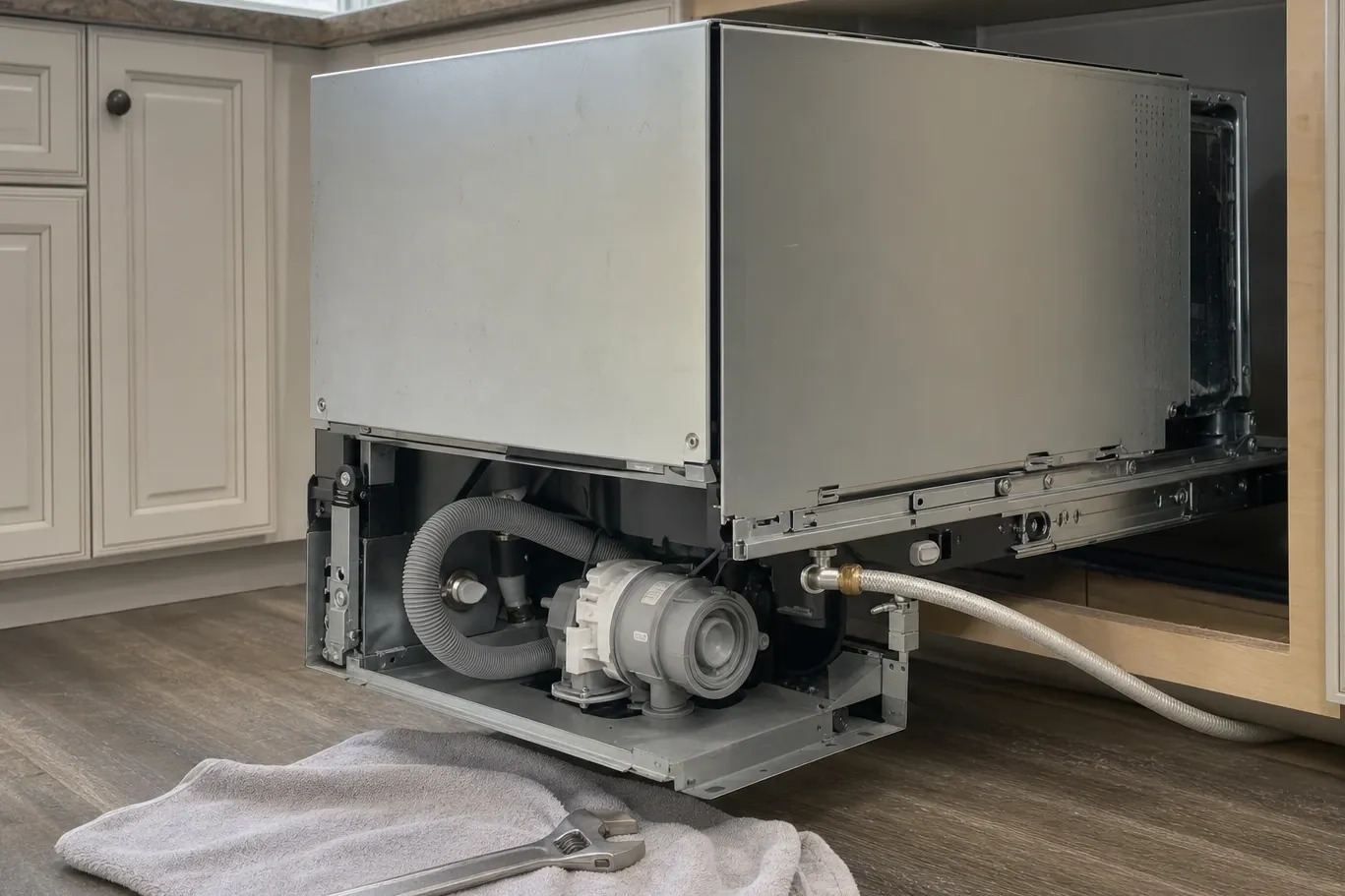
Opening a Viking dishwasher at the end of a cycle and finding standing water is one of the most reported faults in the valley, and one of the most misdiagnosed. Most of the time the pump is fine. What has usually happened is that the drain path has narrowed somewhere between the sump and the waste pipe, and in Phoenix water that narrowing has a familiar cause: scale, plus whatever the scale has caught hold of.
What the standing water tells you
Look at the level before you touch anything, because the height of the water is a clue you only get once. Water sitting just below the top of the filter, roughly where you would expect the sump to hold, means the machine drained and then a small amount came back — a check valve that is not seating, or a drain hose without a high loop letting the sink side siphon back down.
Water level with the door seal, or a tub that is clearly full, means it did not drain at all. That is a blockage, a pump that is not turning, or a machine that never got the command because the cycle stopped early.
Then check whether it is clean water or dirty. Clean water that appears in a machine you have not run is a fill valve leaking by rather than a drain fault, and it is a different repair entirely. Dirty water with food debris in it is drainage.
Check the easy half first
The disposal and the air gap. If the drain hose runs into a disposal, run the disposal for twenty seconds and try a drain cycle. A disposal with waste sitting in it will hold a dishwasher up completely. If a disposal was replaced recently, the moulded drain plug in its dishwasher inlet may still be in place — that stops drainage dead from the first cycle after the plumbing work, which is why it so often turns up right after a remodel.
The filter stack. Twist out the cylindrical filter and lift the flat screen underneath. Rinse both. In hard water these do not just collect food; they build a crust that closes the mesh, and once the mesh is closed the water has nowhere to go.
The sump. With the filters out, look into the recess with a torch. Glass chips, a fruit sticker, a shard of eggshell and — very commonly here — a pale hard flake of scale sitting across the inlet are all things you can remove by hand. Sponge out the water first so you can see what you are doing.
The hose loop. Under the sink, the drain hose should rise to a high point before it turns down to the waste connection. If it lies flat along the cabinet floor, the sink drains back into the dishwasher, and the symptom looks exactly like a failed pump.
Where hard water actually does the damage
Scale does three separate things inside a dishwasher, and only one of them is obvious.
The visible one is the coating: a chalky film on the tub, the element and the racks. It looks bad and it does almost nothing to the machine’s function.
The second is dimensional. Scale builds up in narrow passages, and the drain path has several — the sump inlet, the check valve seat, the corrugations inside the drain hose. A passage narrowed by a millimetre of deposit will block on debris that would have washed straight through when the machine was new. This is why a dishwasher that coped for years suddenly starts holding water every second cycle.
The third is mechanical. A check valve flap coated in deposit does not sit back down cleanly, so water returns from the hose after the pump stops. A drain impeller running in a scaled housing loses efficiency long before it fails outright, and it will move water on an empty test and stall on a full load.
None of that is a reason to replace a machine. It is a reason to treat descaling as maintenance rather than cosmetics, and to expect it to come round again.
The drain path, from sump to disposal
If the easy checks have not cleared it, the path itself needs following in order: sump, inlet to the drain pump, pump impeller, check valve, hose, high loop, air gap if fitted, disposal or waste tee. Each stage either passes water or does not, and the point where it stops is the repair.
That order matters because it stops the pump from being blamed for what is downstream of it. A pump straining against a blocked hose sounds exactly like a pump about to fail, and plenty of them have been replaced while the actual obstruction stayed in the pipe. A technician who tests the pump on its own and then tests the hose separately will not make that mistake.
When it stops being a filter and becomes a pump
There are symptoms that mean the machine needs opening up rather than cleaning out. A drain pump that hums but does not move water has either a jammed impeller or a failed motor. A pump that is completely silent when the cycle should be draining is a wiring, control or motor fault, and that is a meter job. A machine that fills but never attempts a drain, or that stops partway through the cycle and reports an error, has usually decided something itself — a pressure sensor reading a level it cannot explain, or a control that has faulted out.
Water appearing on the floor rather than in the tub is separate again, and worth acting on quickly. A leaking sump seal or a split hose under an integrated machine can run for weeks under the cabinet before it reaches the point where you see it, and in an older kitchen with wood floors that damage costs more than the repair.
When to call
Do the disposal, the filters, the sump and the hose loop yourself. They are safe, they need no tools beyond a torch and a sponge, and between them they account for a large share of what gets reported as a dead dishwasher.
Call when the pump hums without moving water, when nothing at all happens at the drain step, when the machine throws an error and stops mid-cycle, when it drains only sometimes, or when there is any sign of water under the cabinet. Have the model and serial number ready — on an integrated Viking machine it determines which pump, valve and seal kit fit, and knowing it before the visit is often what turns two trips into one.
Follow-up questions
-
Is a little water in the bottom of the tub normal?
A film in the sump recess is normal and keeps the seals from drying out. Standing water deep enough to cover the filter, or water that has risen above the sump plate, is not — that is a drain path that is restricted rather than a machine at rest.
-
Can I fix it by running the disposal?
It is worth doing, and it solves a real share of cases: a disposal full of waste, or a drain plug still fitted to a new disposal, will back a dishwasher up immediately. If the water clears after running it, the fault was never in the dishwasher.
-
Does a hard-water area really change how often this happens?
Yes. Scale narrows the drain path, stiffens the check valve and coats the inside of the pump housing, so the same amount of debris blocks a machine here sooner than it would in a soft-water city. It also means a machine cleaned once will need it again.